
for the fiftieth anniversary of the first permanent SIGINT collection presence on Teufelsberg, the operational home of Field Station Berlin
From T.H.E. Hill, the author of A comparison of Berlin in the 1970s with Berlin in the 2010s, spiced up with the stories of escapades that only ASA-ers could have pulled off. Read an interview with T.H.E. Hill in the Seattle Post-Intelligencer about Reunification: A Monterey Mary Returns to Berlin.
German authors and screen-writers have already begun the process of seeking the literary truth of the meaning of reunification from the German perspective. Wolfgang Becker’s Good Bye Lenin, Thomas Brussig’s Am kürzeren Ende der Sonnenallee, and the Oscar-winner for Best Foreign Picture of 2007, Das Leben der Anderen by Florian Henckel von Donnersmarck are thought-provoking, poignant literary and cinematographic treatments of German reunification from the German perspective. They are sure to become classics. They are being joined by non-fiction works like Andreas Glaeser’s Divided in Unity: Identity, Germany, and the Berlin Police, and Jana Hensel’s After the Wall, which looks at the last generation of East-German children. The American perspective of the reunification of Berlin, however, was sadly lacking. For almost fifty years—from 1945 to 1994—there was a large and vibrant American Community in Berlin. It stood shoulder-to-shoulder beside the Berliners during the Airlift, and through the Wall from rise to fall. It deserved to have a literary resolution to its disappearance. Reunification tells that story.
Winner of the Stars and Flags Gold Award in the category "General Fiction" for 2013. The term “Ostalgie” was coined by East German cabaret artist Uwe Steimler in 1992. It refers to a nostalgia for the way life was in the GDR. It has been widely discussed in both German and International scholarship, in particular in studies of post-reunification German literature. Around the end of the first decade following the Fall of the Berlin Wall, the term “Westalgie” began to be seen. Among Berliners, it refers to a nostalgia for the way things were in West Berlin before reunification. Reunification: A Monterey Mary Returns to Berlin is clearly a “Westalgie” novel. |
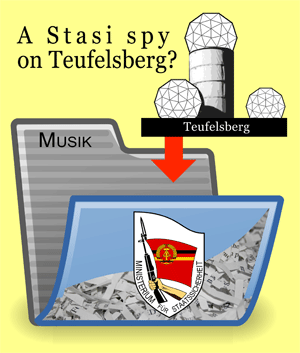
Mike Troyan got to know the divided city of Berlin as a Monterey Mary at the Army Security Agency Field Station there. His peaceful retirement from the CIA is derailed when he returns to post-Wall, reunified Berlin to write a book about the Stasi, and one of the ghosts of his Berlin past sends him to the ER to be stitched together on the evening of his first day back. This does not bode well for his project, because this ghost is Ilse, the mother of the Director of the Stasi Archive where Mike will be working. She used to be Mike’s long-haired dictionary. She is clearly not happy to see him. The plot thickens when Mike reads his own Stasi file, and discovers that someone was reporting on him to the Stasi while he was at the Field Station. Standard counter-intelligence logic suggests that the Stasi source was Ilse, but Mike does not want that to be the case, because it would mean that he was wrong, and Security was right. He scours the darkened recesses of his memory in search of other suspects for the title of Musik, the covername for the Stasi asset reporting on him. Wearing his case-officer hat, Mike imagines how easy it would have been for him to recruit each of the rogues’ gallery of characters he served with in ASA at Field Station Berlin. Mike's search for Musik is complicated by the fact that the Musik files were shredded when the Berlin Wall fell. Shredding, however, was only secure before today's computers, so Mike and the reader have to be patient while the computer pieces together the Musik files from the piles of shredded Stasi documents so that Mike can identify the penetration at Field Station Berlin. Then add an IRA informant in witness protection who thinks that Mike is a hit man sent to settle an old score. Serve stirred, not shaken in the form of a classic espionage whodunit, garnished with a dash of moral ambiguity provided by the people that Mike meets in his travels around Berlin who force him to compare the Old Berlin to the New, and the CIA to the Stasi. Who was Musik? That would be telling, and that’s Mike’s rice bowl. He’s the narrator. You’ll have to hear it from him. Read a sample of what he has to say.  The "Book of the Month" for "Summer 2013" at BerlinBrigade.com
|

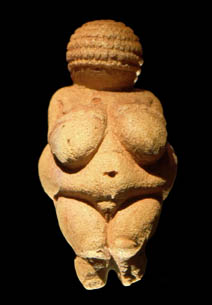
The sign on the door of the Ladies’ toilet at Bar Gagarin in the Old-East district of Prenzlauer Berg has a lot in common with the Venus of Willendorf in the Naturhistorisches Museum in Vienna.
 |
 |
Venus of Willendorf |
sign on the door |
Find out why a retired spy might notice the similarity. (The answer is on page 148.)

